
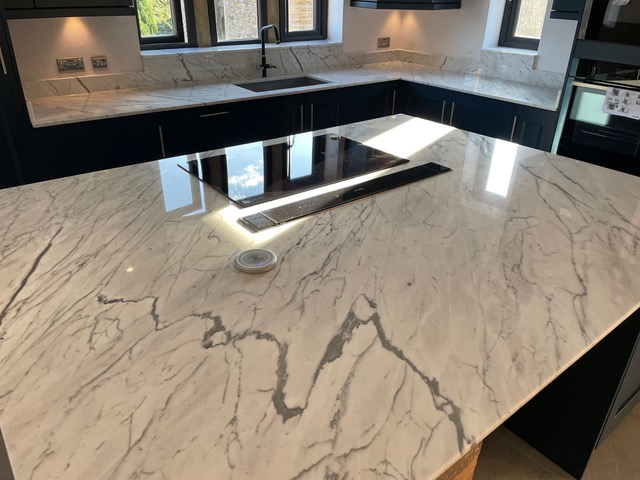
Choosing a new kitchen worktop is a big decision. It needs to look fantastic, fit your kitchen perfectly and stand up to everyday use for many years.
Two of the most popular choices are granite and quartz worktops. Both offer a premium finish and can transform the appearance of a kitchen, but they have some important differences.
So, which is better: granite or quartz?
The honest answer is that it depends on your kitchen, your lifestyle and what matters most to you.
At Granite Worktops UK Ltd, we have been working with granite and quartz since 1998, and Paul has been in the industry since 1987. Here’s our straightforward guide to help you decide.
What is the difference between granite and quartz?
Granite is a natural stone, quarried from the earth and cut into slabs for use as kitchen worktops. Every piece of granite is naturally different, which means your worktop will have its own unique colour, pattern and character.
Quartz worktops are engineered surfaces, manufactured using natural quartz combined with resins and pigments. This allows manufacturers to produce a much wider range of consistent colours and patterns.
Neither material is simply “better”. They have different characteristics that may make one more suitable for your kitchen than the other.
Granite vs quartz: appearance
If you want a completely natural stone with unique variations, granite is an excellent choice.
No two granite slabs are exactly the same. Natural movement, flecks, veins and colour variations are part of what makes granite so appealing.
Quartz, on the other hand, offers much more consistency. If you have seen a particular quartz colour that you love, you can expect the finished worktop to closely follow that design.
Modern quartz is available in an enormous range of colours and styles, including designs that replicate the appearance of natural stone.
Which looks better?
That’s entirely personal.
Some people love the natural character of granite, while others prefer the clean, consistent appearance of quartz.
Which is more durable, granite or quartz?
Both granite and quartz are extremely durable kitchen worktop materials when properly manufactured and installed.
Granite is a hard natural stone that has been used in kitchens for many years. It is resistant to everyday wear and can provide an exceptionally long-lasting work surface.
Quartz is also highly durable and is designed for everyday kitchen use.
However, durability isn’t just about the material itself.
The quality of the slab, fabrication, edge profile, cut-outs and installation can all make a difference to the finished worktop.
This is one reason we believe experience matters. A beautiful slab still needs to be accurately templated, manufactured and fitted correctly.
Is granite more heat resistant than quartz?
This is one of the biggest differences to consider.
Granite has excellent heat resistance, making it particularly suitable for people who do a lot of cooking.
Quartz should be treated with more care around very hot cookware because the resin used in engineered quartz can be affected by extreme heat. We always recommend using trivets or heat protection rather than placing very hot pans directly onto a quartz worktop.
If you regularly cook with very hot pans, this is something worth considering when choosing between granite and quartz.
Does granite or quartz stain?
Quartz is a popular choice for busy kitchens because it is a low-maintenance, non-porous engineered surface.
Granite is also highly practical, but because it is a natural stone, some varieties can benefit from sealing to help protect against staining.
The exact characteristics can vary considerably between different types of granite, so it’s worth discussing the particular stone you’re considering rather than assuming every granite behaves in exactly the same way.
Which is easier to maintain?
Both materials are relatively easy to look after.
For everyday cleaning, a soft cloth and suitable cleaning product are generally all that’s required.
Quartz is particularly attractive to homeowners who want a low-maintenance kitchen worktop.
Granite may require occasional sealing depending on the particular stone and the manufacturer’s recommendations.
With either material, good care will help keep your worktop looking beautiful for years.
Is granite or quartz cheaper?
There isn’t a simple answer.
The price of a worktop depends on far more than whether you choose granite or quartz.
Factors include:
- The particular stone or quartz colour
- The thickness of the slab
- The size of your kitchen
- Number and size of cut-outs
- Sink and hob cut-outs
- Drainer grooves
- Edge profiles
- Upstands and splashbacks
- Installation requirements
- Access to the property
This is why we recommend getting a quotation based on your actual kitchen rather than relying solely on an advertised price per square metre.
Granite or quartz: which should you choose?
If you want natural stone, unique character and excellent heat resistance, granite could be the right choice.
If you want a consistent design, a huge choice of colours and a low-maintenance surface, quartz could be the better option.
Ultimately, there isn’t a single “best” worktop for every kitchen.
The right choice depends on how you use your kitchen, the look you want and your budget.
See granite and quartz worktops for yourself
If you’re unsure which material is right for your kitchen, we’d always recommend looking at actual slabs and samples rather than choosing solely from photographs.
At Granite Worktops UK Ltd, we can help you compare different granite and quartz worktops and discuss what would work best for your kitchen.
We’ve been designing, manufacturing and installing stone worktops since 1998, with Paul personally involved from templating through to installation.
Contact us to discuss your kitchen worktop.

